

What it is
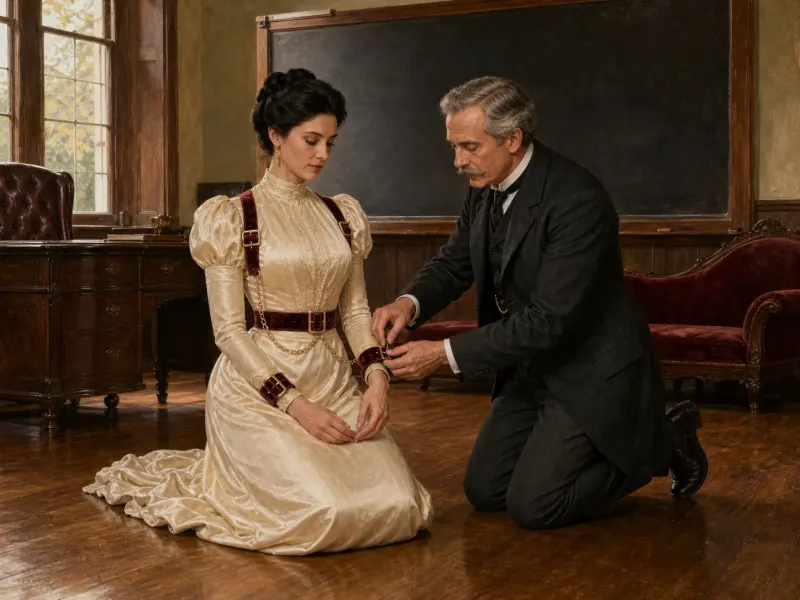
The wearer kneels on padding with cuffed wrists held at a comfortable height in front of the body. The attraction is not complexity for its own sake, but clarity: each person can see what is being limited, what remains free and how the arrangement will be undone. The Audience belongs to the Atlas because it offers a distinct piece of restraint geometry without relying on explicit activity. Before beginning, agree the intended shape in ordinary language and choose the most conservative range that still feels intentional. A composed position should look considered rather than strained; if the body has to fight the arrangement, the arrangement needs changing.
What you’ll need
Required
- two padded wrist cuffs
- short connector
Optional
- a folded blanket for support
- a discreet timer for check-ins
- a second release tool
Setting the position
- 01
Place the required equipment and release method within reach, then clear and stabilise the supporting surface.
- 02
Agree the stop word, non-verbal signal, expected duration and the order in which every restraint will be released.
- 03
Let the wearer settle into the kneeling posture without restraint and adjust support until breathing and balance feel unremarkable.
- 04
Fit two padded wrist cuffs without loading it, checking that skin, hardware and soft tissue are not pinched.
- 05
Connect one point at a time, keeping the range modest, then perform a full circulation, communication and release check.
Why people choose it
The Audience is useful when the desired atmosphere is precision rather than spectacle. Its kneeling line is immediately legible, which makes it easier to discuss before anyone is committed to it. The position also leaves room for deliberate pacing: it can remain simple, or sit between less and more restrictive arrangements in a sequence. That sense of order is rather the point. The equipment has a job, the body has support, and nobody needs to improvise the escape route halfway through the evening. Because this belongs to the kneeling family, plan the exit before the entrance. Release the relevant hardware before asking for a change of level or direction; even a technically easy transition is a fresh consent moment.
Comfort & mobility
This is a self-supported arrangement with some balance demand. Knee loading is present, so generous padding and short intervals matter. Shoulder range is generally ordinary, provided the chosen restraint points remain below the wearer’s comfortable limit. Hip opening should never be forced. Change or end the position before fatigue turns a neutral posture into a demanding one.
Safety notes — always visible
Before the position is loaded
consent
Agree the position, expected duration, permitted adjustments and stop signal before arranging any equipment. Consent remains reversible throughout.
communication
Normal speech should remain possible. Agree a plain stop word and a non-verbal signal before beginning, then check in without waiting to be asked.
circulation
Check skin colour, temperature, sensation and ordinary movement beyond every cuff. Numbness, tingling, coldness, swelling or discolouration means immediate release.
release
Identify every buckle, clip and anchor before loading the position. Quick-release hardware must remain accessible to the active partner at all times.
stop Conditions
Stop at once for numbness, pins and needles, cold or discoloured skin, sharp joint pain, breathing difficulty, dizziness, panic, confusion or any withdrawal of consent.
Alter the measure
Make it gentler
Use fewer restraint points, shorten the interval and keep the wearer more fully supported. Preserve ordinary movement in at least one pair of limbs.
More restrictive
Add only one controlled variable at a time, such as a second restraint point. Reconfirm consent and repeat the release check before treating it as a new position.
Questions answered
Is The Audience suitable for beginners?
It is classified as Familiar, not First Evening. The arrangement remains physically clear but assumes familiarity with cuff fit, monitoring and calm position changes. A simpler position from the same equipment collection is a better place to establish communication and release habits.
What equipment does The Audience require?
The required items are two padded wrist cuffs, short connector. Equipment should be in good condition, correctly sized and tested for release before it is placed under tension.
How long should the position be held?
There is no universal safe duration. Use short planned intervals, check sensation and circulation frequently, and end before fatigue, numbness or discomfort appears.
What should be checked during restraint?
Check communication, breathing, balance, skin colour, warmth, sensation and ordinary movement beyond each restraint. Any concerning change means release first and discussion afterwards.