What it is
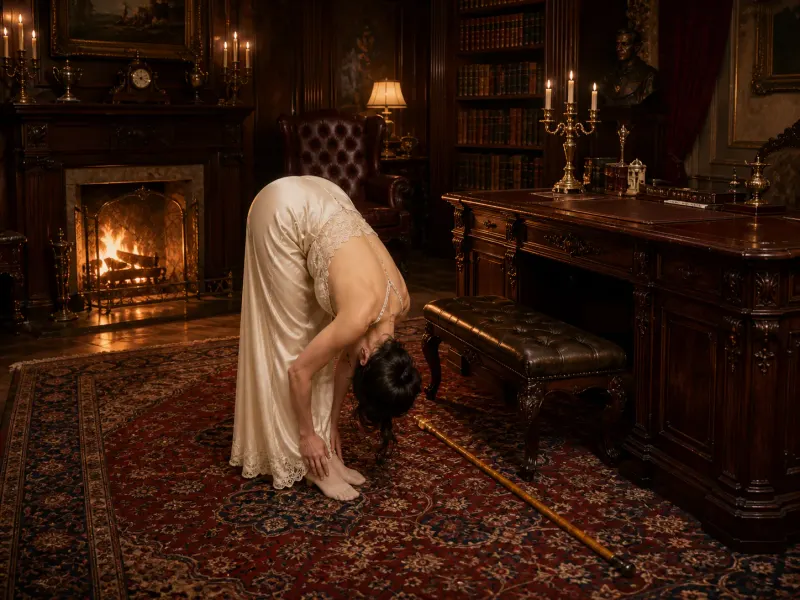
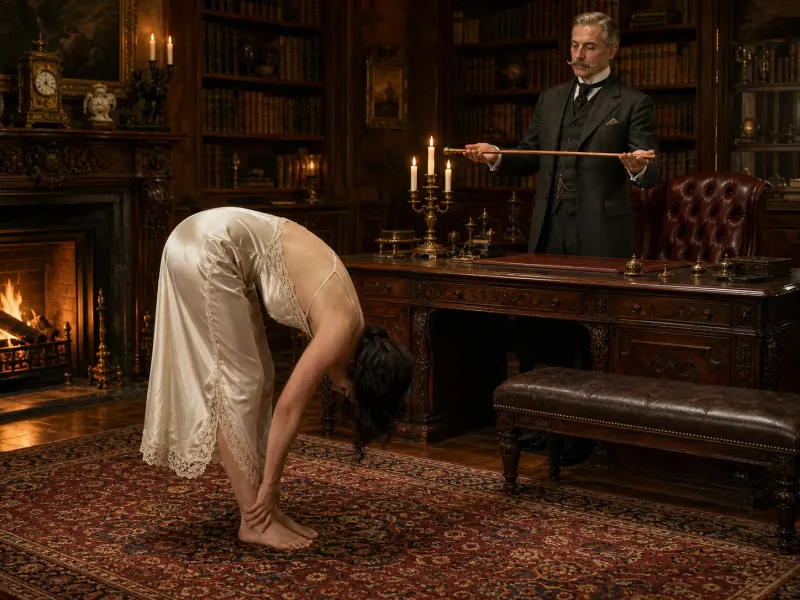
The wearer bends forward from standing to hold the shins or a low stool, knees soft, so the seat is fully presented while the head rests below the hips. This is one of eight impact positions in the Atlas: arrangements whose purpose is to present the body’s padded, muscular areas — the lower buttocks and the backs of the thighs — steadily and comfortably, while keeping everything fragile out of the line of play. The strictest posture in the family: blood runs toward the head and hamstrings tire, so sets are short, counted and precise — which is precisely the discipline aesthetic the position exists to serve. As with every plate in this catalogue, the position is agreed in ordinary language first, the warm-up is unhurried, and the wearer’s report — not the implement — sets the pace.
What you’ll need
Required
- excellent footing and a clear floor
- a rattan cane or riding crop
Optional
- a soft blanket over the target area for warm-up strokes
- arnica or a cooling balm for afterwards
- a discreet timer for set lengths
- a mirror so the wearer can watch, if agreed
Setting the position
- 01
Clear a full swing arc around the position, lay the implements where both partners can see them, and stabilise the floor and the supporting furniture or wall.
- 02
Agree the implements, the intensity ceiling on a one-to-ten scale, whether marks are acceptable, the areas in play, the stop word and the non-verbal signal.
- 03
Let the wearer settle into the standing posture and adjust support until it could be held comfortably for the length of a conversation.
- 04
Warm up with the open hand or the softest implement: light, rhythmic strokes across the lower buttocks and backs of the thighs until the skin is warm and rosy. Warm-up is not optional; it is what makes intensity safe.
- 05
Escalate one step at a time — firmer strokes, then a firmer implement — checking the scale between sets. End with slow strokes, stillness, and unhurried aftercare for both partners.
Why people choose it
This is cane territory: the fold pulls the skin taut over exactly the areas caning is for, and the stillness the position demands suits the cane’s counted, ceremonial pace. Crops serve lighter sessions. The strictest posture in the family: blood runs toward the head and hamstrings tire, so sets are short, counted and precise — which is precisely the discipline aesthetic the position exists to serve.
Comfort & mobility
This is a self-supported arrangement with a meaningful balance demand. There is no kneeling load. Shoulder range is generally ordinary, provided the chosen restraint points remain below the wearer’s comfortable limit. Hip opening should never be forced. Change or end the position before fatigue turns a neutral posture into a demanding one.
Safety notes — always visible
Before the position is loaded
consent
Agree the implements, the intensity ceiling, the areas that may be struck, whether marks are acceptable and the stop signal — all before the first stroke. Consent to impact is specific: a yes to the paddle is not a yes to the cane.
communication
Use a plain stop word plus a one-to-ten intensity scale between sets, so escalation is a decision rather than a drift. The active partner asks; the wearer never has to volunteer.
circulation
Impact lands only on padded, muscular areas: the lower half of the buttocks and the backs of the thighs. The spine, tailbone, kidneys and flanks, neck, head, joints and the hollows behind the knees stay entirely out of bounds. Watch the skin between strokes — deepening colour is expected, broken skin, welts beyond what was agreed, or numbness at the site means the set ends.
release
In most impact positions the wearer is not mechanically restrained — the exit is simply standing up, and that exit stays available at all times. If restraint is added from another collection, its quick-release rules apply unchanged, and the implements go down before any release begins.
stop Conditions
Stop at once for the stop word or signal, broken or split skin, numbness or shooting pain at the strike area, strikes that land off-target, dizziness, nausea, panic, or any withdrawal of consent. Aftercare is part of the scene, not an optional extra.

Alter the measure
Make it gentler
Keep the open hand or the softest flogger, work over fabric or a draped blanket rather than bare skin, halve the set length and stay at the low end of the agreed scale. A warm-up-only session is a complete session.
More restrictive
Introduce a firmer implement one step at a time — paddle before crop, crop before cane — or add wrist restraint from the cuffs collection once the impact rhythm is established. Change one variable per scene, and re-confirm consent when the implement changes.
Questions answered
Is The Deep Bow suitable for beginners?
It is classified as Advanced. The position places unusual demands on shoulder range, balance or access to release and should be approached only with relevant experience. The Governess’s Lap or The Tabletop are the better places to learn warm-up, rhythm and the intensity scale first.
Which implement suits The Deep Bow?
This is cane territory: the fold pulls the skin taut over exactly the areas caning is for, and the stillness the position demands suits the cane’s counted, ceremonial pace. Crops serve lighter sessions.
Where should impact land — and where must it never land?
Only on padded, muscular areas: the lower half of the buttocks (the “sit spot”) and the backs of the thighs. Never the spine, tailbone, kidneys or flanks, neck, head, hands, feet, joints or the hollows behind the knees. With floggers and whips, account for wrap — tips that curl past the target onto the hip bone or flank.
How hard is too hard?
Intensity is agreed on a one-to-ten scale before the scene and reported between sets — escalation is a decision, never a drift. Always warm up with light, rhythmic strokes until the skin is warm before anything firm. Broken skin, welts beyond what was agreed, or numbness ends the scene.
Will it leave marks, and what about aftercare?
Warm colour fades within hours; paddles can bruise, and canes characteristically leave parallel lines that may last days — which is why marks are agreed in advance. Afterwards: cool water or a cooling balm on the area, warmth for the person, water to drink, and unhurried closeness. Both partners receive aftercare; drop can visit either.